
Ukrainians consider digitalization to be main success of 2025, and the fight against corruption to be failure, according to survey by Active Group
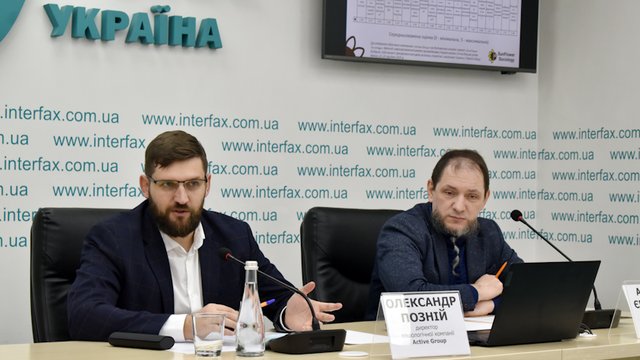
Among the areas of public policy in 2025, Ukrainians rated the digitization of public services most highly and the fight against corruption in government most poorly, according to the results of a nationwide sociological survey by Active Group, presented at a press conference at the Interfax-Ukraine agency on Tuesday.
“The only area that citizens perceive as an unconditional success with a clear practical effect on everyday life is the digitization of public services. The average rating is 2.92,” said Active Group co-founder Alexander Pozniy.
According to the study, Ukrainians also considered the promotion of Ukraine's interests in the international arena (2.57) and the restoration of energy infrastructure after shelling (2.41) to be relatively successful areas. Attracting foreign investment (2.38) and developing the defense-industrial complex (2.23) also received above-average ratings.
In the middle of the scale were the improvement of the education system (2.18), the approach of a favorable end to the war for Ukraine (2.16), and the functioning of the healthcare system (2.15). Respondents rated the development of defense forces and high-quality mobilization at 2.08 points, social protection for veterans at 2.02, and support for socially vulnerable groups at 1.92.

The economic sector received lower ratings: overall economic development – 1.87, improvement in the work of law enforcement agencies – 1.80, and support for small and medium-sized businesses – 1.67. Respondents rated the return of people from abroad at 1.65 and the improvement in the demographic situation at 1.61.
According to the survey, the most problematic areas remain improving the judicial system (1.55) and reforming the system of government (1.51). The fight against corruption in government received the lowest rating of all areas, at 1.36.
“The 1.36 rating for the fight against corruption is a marker of major public disappointment and an area where people do not see systemic changes,” Pozniy said.
A separate section of the study concerned awareness of and trust in law enforcement and anti-corruption institutions. The most well-known remain the Armed Forces of Ukraine, which 89.6% of respondents had heard of, the SBU (76.8%), and the GUR (74.3%). Among anti-corruption bodies, the NABU (71.6%) and the MIA (65.1%) have a high level of recognition, while 37.4% have heard of the SAP, 36.7% of the VAKS, 34.6% of the NAZK, 33.6% of the BEB, and 31.5% of the Office of the Prosecutor General.

According to Active Group co-founder Andriy Yeremenko, the dynamics of trust in December 2025 showed growth primarily in the Defense Forces. “The Armed Forces of Ukraine remain the undisputed leader in terms of trust: 65.5% trust them in December, which is 13.2 percentage points more than in September—the largest increase among all structures,” he said.
According to the survey, trust in the Security Service of Ukraine (SBU) stands at 38.5% (+2.0 percentage points), and in the Main Intelligence Directorate (GUR) at 36.1% (+1.9 percentage points). Among anti-corruption agencies, the share of those who trust the NABU has grown to 23.6% (+3.2 p.p.), and the BEB to 7.8% (+3.2 p.p.).
At the same time, there has been a decline in trust in a number of institutions: the SAPO to 7.3% (-5.7 p.p.), the NACP to 3.5% (-5.8 p.p.), the VAKS to 4.1% (-2.4 p.p.), and the SBI to 9.7% (-2.4 p.p.). Trust in the Office of the Prosecutor General was 2.1%, with the institution being measured for the first time. The share of respondents who said they did not trust any of the listed structures was 20.8% (-3.3 p.p. compared to September).
The survey was conducted by Active Group on December 21-23, 2025, using the SunFlower Sociology online panel, with self-completed questionnaires by Ukrainian citizens aged 18 and older. The sample size was 2,000 questionnaires, with a theoretical margin of error of no more than 2.2% at a confidence level of 0.95.