

Council of Europe Secretary General: Intl Claims Commission to be second independent component on compensation for Russia's aggression
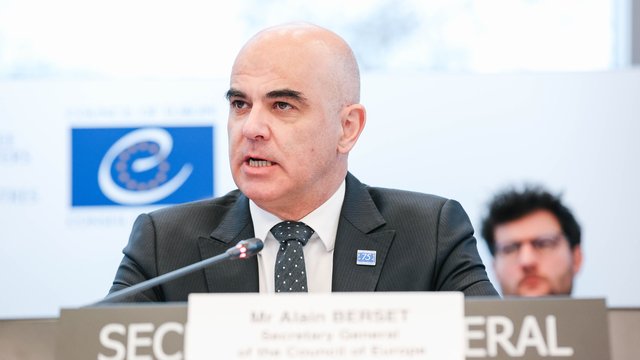
The Council of Europe and the Netherlands are convening leaders and senior policymakers from European countries and beyond for a Diplomatic Conference aimed at establishing an International Claims Commission for Ukraine.
The relevant Convention establishing the Commission will be adopted on December 16 in The Hague at a Diplomatic Conference to be held at the World Forum venue.
The Secretary General of the Council of Europe, Alain Berset, told Interfax-Ukraine: "Ensuring accountability for the appalling damage and loss suffered by Ukraine and its people has been central to the Council of Europe’s work over the past years. By launching the Convention on the international claims commission for Ukraine, the Council of Europe takes a hugely important step towards the setting up of an international compensation mechanism. The Register of Damage for Ukraine – its first component – and the International Claims Commission, the second one, will be the independent international tools dealing with the question of compensation for Russia’s aggression."
As is known, the Register of Damage for Ukraine was established in 2023 and collects and records compensation claims submitted by individuals, organizations, and state authorities in Ukraine. To date, 44 states and the European Union have joined the Register, and more than 80,000 claims have already been filed.
The Council of Europe’s Media Department explained that for the International Claims Commission to be established, the Convention that creates it must first enter into force. This Convention will be adopted and opened for signature on 16 December in The Hague. From that date onward, members and non-members of the Council of Europe will be able to sign it. Afterwards, it will need to be ratified.
The Convention will enter into force after 25 such ratifications. It is expected that more than a dozen states and organizations will sign the new Convention in The Hague next week.
The Secretary General said: "The overwhelming support we have witnessed during the negotiations of the convention is proof of the determination of the Council of Europe members and other states and organisations to hold Russia accountable for its internationally wrongful acts in and against Ukraine. We look forward to the first signatures next week in The Hague and trust that other states will join soon."
The Media Department of the Council of Europe said that the International Claims Commission will consist of Members (the states or regional integration organisations that became parties to the convention). Members will participate in the governance of the Claims Commission through various bodies (the Assembly and the Council, as well as of the Financial Committee). The claims will be examined by panels of Commissioners – independent experts in fields such as international law, dispute resolution, damage assessment, who will work in their personal capacity. The Convention requires that the panels of Commissioners must follow the highest standards of independence, impartiality fairness and objectivity.
The Executive Director who will represent the commission and act on its behalf, will be elected by its assembly bringing together all the Members and appointed by the Secretary General of the Council of Europe, for a renewable term of 4 years. The director will lead a secretariat that will support the functioning of the commission.
As for the sources of funding for the Commission’s work, the Council of Europe said that it will have its own budget within the framework of the Council of Europe. It is expected that the Russian Federation, should it become a member, will bear the costs of the work of the commission. Until then, the Commission will be financed through the annual assessed contributions of members and through voluntary contributions.
The Council of Europe also said that the commission will decide on the claims submitted to and recorded by the Register of Damage, as well as submitted directly to the commission after its establishment. "As soon as possible after the commission will be set up, the work of the Register (including its digital platform, all information about claims and evidence, other documents and archives, its property, etc.) will be transferred to the commission, ensuring the uninterrupted operation of the Register until its termination. So, the functions of the register (receiving and recording claims) will continue as part of the commission," detailed the Media Department.
As for the mechanism for assessing damages, the Council of Europe said that claims for damage will be examined by panels of commissioners who will decide if the claims are substantiated, and determine any amount of compensation.
As for the issue of compensation payments, it still requires discussion. "The International Claims Commission is the second step in the international compensation mechanism, after the Register of Damage. The third step, namely a compensation fund, and the modalities of its functioning, still needs to be discussed. Interested parties are continuing to explore possible sources of funding for the compensation that will be determined and awarded by the Claims Commission," the Council of Europe said.
While an ad-hoc review possibility is foreseen in the process of deciding on the claims, within the commission, its final decisions will not be subject to further appeal or review. "The Commission will operate in a transparent manner and regularly inform the public about its activities. The Commission, including its Council, Panels and the Secretariat, will operate according to the highest standards of independence, impartiality, fairness and objectivity," assured the Media Department.